
Most guides to call center outsourcing cost are written by software companies trying to sell you a dialer. This one isn’t – it’s written by a real US-based call center outsourcing operator who has staffed these programs, broken down the way we’d explain it to you over a call, not the way a vendor’s marketing team wants it to look on a landing page.
How much does call center outsourcing cost?
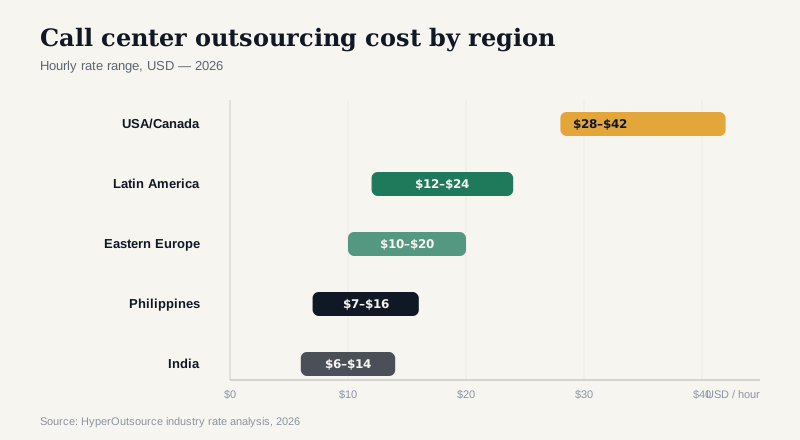
US-based agents run $28–$42/hour, Philippines-based agents run $7–$16/hour, and Latin America runs $12–$24/hour. Most SMBs running a small-to-mid-size program spend $8,000–$35,000/month total, depending on agent count, hours of coverage, and channel mix.
The 5 Pricing Models (And What Each One Actually Rewards)
Outsourced call center pricing isn’t one number – it’s one of five structures, and each one incentivizes different behavior from your provider. Understanding which model you’re being quoted matters more than the headline rate.
Per-Hour Pricing
You pay for agent time, regardless of call volume in that hour. This is especially common for outbound call center services, where dial pace and call length vary too much to price cleanly per minute.
- Pro: Predictable, easy to budget, simple to audit against a timesheet.
- Con: You pay the same rate whether the agent is slammed or idle, so slow periods cost you full price.
Per-Minute Pricing
You pay only for talk time, typically $0.50–$1.75 per minute depending on region and complexity.
- Pro: You only pay for actual work performed, which rewards efficiency.
- Con: Providers can be incentivized to rush calls to hit volume, which can hurt resolution quality if not monitored closely.
Per-Agent Retainer
A flat monthly fee per dedicated agent, regardless of hours worked in a given week.
- Pro: You get a dedicated, trained agent who isn’t shared across other client accounts.
- Con: You’re paying for a full seat even during your slowest weeks of the year.
Pay-Per-Resolution
You pay only when a ticket or call is fully resolved, not for time spent.
- Pro: Directly aligns cost with outcomes – you’re not paying for unresolved calls.
- Con: Hard to price accurately upfront, and can push agents toward closing tickets prematurely to hit resolution counts.
Monthly Flat Fee
One number covers a defined scope of hours, agents, and channels for the month.
- Pro: The simplest model to budget against, with no surprise line items.
- Con: Least flexible – if your volume spikes mid-month, you’re either paying overage fees or your service level drops.
Regional Cost Table: Where Your Money Actually Goes
Region drives the largest swing in call center cost per agent, more than any other single factor. Here’s what each major outsourcing region actually costs, and what it’s realistically best suited for.
| Region | Per-Hour (Low) | Per-Hour (High) | Per-Minute | Best For |
|---|---|---|---|---|
| USA/Canada | $28 | $42 | $1.10–$1.75 | Regulated industries, complex support, brand-sensitive calls |
| Latin America | $12 | $24 | $0.65–$1.20 | Bilingual support, US time-zone alignment, mid-complexity work |
| Philippines | $7 | $16 | $0.50–$0.90 | High-volume, cost-sensitive inbound support and back-office work |
| India | $6 | $14 | $0.45–$0.85 | Technical support, high-volume outbound, 24/7 coverage |
| Eastern Europe | $10 | $20 | $0.60–$1.10 | European-language support, technical and B2B accounts |
The gap between US and Philippines pricing isn’t arbitrary – it reflects real differences in cost of living, and it maps directly to what you should expect in terms of accent neutrality, product complexity handling, and time-zone overlap.
Industry-Specific Costs (What Generic Guides Miss)
BPO outsourcing rates don’t move in a vacuum – the industry you’re in changes what you’ll actually pay, often more than the region does.
eCommerce
Costs stay close to baseline rates since most volume is order status, returns, and shipping questions – repetitive, script-friendly work. Seasonal spikes (holiday, back-to-school) are the real cost driver here, not per-call complexity, and providers often charge a 10–20% premium for guaranteed peak-season staffing.
Healthcare
Expect a +15–30% premium over baseline rates for HIPAA-compliant programs. That premium covers agent background checks, encrypted call recording and storage, restricted data access controls, and compliance training that non-healthcare accounts don’t require. Skipping this premium by hiring a non-compliant provider is a liability risk, not a savings.
SaaS/Tech Support
Runs higher than average because agents need product training depth, not just script fluency. Tiered support models (Tier 1 triage outsourced, Tier 2/3 kept in-house) are common here specifically to control cost while keeping complex troubleshooting internal.
Real Estate
Costs skew toward outbound and lead-qualification work rather than inbound support, so pricing is often closer to per-resolution or per-qualified-lead models rather than flat hourly rates, since the value of the call is tied to the outcome, not the time spent.
Hidden Costs Nobody Tells You About
The quoted hourly or per-minute rate is never the full cost of a program. These six line items are where budgets quietly blow past projections.
- Setup/onboarding: $2,000–$10,000 one-time, covering process documentation, systems access, and initial ramp.
- Training and turnover: $1,000–$2,000 per agent, every time an agent is replaced – and call center turnover is high industry-wide, so this isn’t a one-time cost.
- QA analyst: $500–$2,000/month if you want dedicated quality monitoring rather than relying solely on the provider’s internal QA.
- Tech/CRM integration: $50–$200 per agent per month for connecting your CRM, helpdesk, and phone systems into the provider’s stack.
- After-hours premium: An additional 15–50% on top of standard rates for evening, weekend, or holiday coverage.
- Early termination penalty: 2–6 months of fees if you exit a contract before the committed term ends – read this clause before you sign anything.
Ask for all six of these explicitly in writing before you sign. A quote that only shows the hourly rate is an incomplete quote.
SMB Volume-Based Pricing: What You’ll Actually Pay
Customer service outsourcing cost scales in steps, not smoothly – each volume tier tends to map to a different pricing model as the economics shift. Once volume gets consistent enough to justify dedicated staffing, most SMBs move to a per-agent retainer for inbound customer support rather than staying on per-minute billing.
| Monthly Call Volume | Agents Needed | Est. Monthly Cost | Recommended Model |
|---|---|---|---|
| Under 1,000 | 1–2 | $2,500–$7,000 | Per-minute or per-hour |
| 1,000–5,000 | 3–8 | $8,000–$18,000 | Per-agent retainer |
| 5,000–15,000 | 8–20 | $18,000–$35,000 | Per-agent retainer or flat monthly |
| 15,000+ | 20+ | $35,000+ | Flat monthly fee with volume tiers |
Below 1,000 calls a month, per-minute pricing almost always wins because a dedicated retainer sits idle too much of the time. Once you cross into consistent daily volume, a retainer or flat fee starts winning on predictability.
One thing worth deciding before you price anything out: are you actually shopping for a plain call center, or do you need contact center services that unify phone with chat and email? The two aren’t priced or scoped the same way.
Red Flags in Pricing Quotes
Watch for these five patterns before signing anything – each one has cost buyers money later when ignored.
- No mention of after-hours or holiday premiums. If the quote doesn’t address weekend or evening coverage cost, assume it’s not included, and you’ll find out the hard way during your first busy weekend.
- A rate dramatically below the regional range. Rates 30%+ below what a region typically charges usually mean undertrained agents, high turnover, or shared (not dedicated) staffing that gets pulled onto other client accounts during your peak times.
- Vague or missing termination terms. If the contract doesn’t clearly state the exit penalty and notice period, assume it’s unfavorable to you – providers rarely leave a good clause out by accident.
- No QA or reporting cadence specified. A quote with no mention of how quality is measured or reported means you’re buying a black box, not a program you can manage.
- Setup fees bundled invisibly into month-one billing. If onboarding costs aren’t broken out separately, you can’t tell whether you’re being overcharged for setup or being quoted a misleadingly low ongoing rate.
ROI Calculation: In-House vs. Outsourced
The formula is straightforward:
ROI = (In-House Annual Cost − Outsourced Annual Cost) / In-House Annual Cost
Worked example – 10-agent team, US market:
In-house (10 agents):
- Salary: $38,000/agent/year average = $380,000
- Benefits (25% loaded): $95,000
- Management/supervisor overhead: $65,000
- Software, seats, equipment: $40,000
- Total in-house: $580,000/year
Outsourced (10 agents, Philippines retainer at $11/hour):
- $11/hour × 10 agents × 2,080 hours/year = $228,800
- Add setup, QA, and integration costs (~$40,000/year): $268,800 total
ROI on the Philippines example: ($580,000 − $268,800) / $580,000 = 53.7% cost reduction
The math only favors outsourcing when you’re comparing against the right region for your complexity and compliance needs – comparing US in-house against US outsourced rarely shows dramatic savings on labor cost alone. These figures are still averages; the fastest way to know your real number is to get a custom pricing estimate based on your actual volume and region mix.
AI vs. Human Outsourcing: A Balanced Take
AI-handled calls run $0.07–$0.15 per minute – a fraction of the $0.50–$1.75 per minute for human agents. That gap is real, and it’s tempting to read it as “just use AI.” It isn’t that simple.
AI performs well on routine, scriptable interactions: order status, appointment confirmations, basic FAQs, and after-hours triage. It performs poorly on anything requiring judgment, empathy, de-escalation, or handling an angry customer who wants to feel heard, not routed. Healthcare and high-value B2B accounts in particular still see meaningfully better outcomes with human agents on anything beyond basic triage.
For most SMBs, a hybrid model is the practical answer: AI handles the routine volume that doesn’t need a human, and trained agents handle everything else. This isn’t a compromise position – it’s usually the actual lowest-cost-per-resolved-issue approach once you account for the cost of AI mishandling a complex call and losing the customer entirely.
Frequently Asked Questions
How much does call center outsourcing cost per hour?
Rates depend heavily on region: $28–$42/hour for US/Canada-based agents, $12–$24/hour for Latin America, and $7–$16/hour for the Philippines. Complexity, compliance requirements, and coverage hours all push rates toward the top of each range.
What’s the cheapest region for call center outsourcing?
India and the Philippines offer the lowest hourly rates, typically $6–$16/hour. That said, the lowest rate isn’t automatically the best value – factor in accent neutrality, time-zone overlap, and complexity handling before choosing purely on price.
Is per-minute or per-hour pricing better for a small business?
Per-minute pricing ($0.50–$1.75/minute) tends to favor low, inconsistent call volume since you only pay for actual talk time. Per-hour or retainer pricing becomes more cost-effective once you have consistent daily volume that justifies a dedicated agent.
What hidden costs should I budget for beyond the quoted hourly rate?
Budget for setup/onboarding ($2,000–$10,000), agent training and turnover ($1,000–$2,000/agent), QA analyst time ($500–$2,000/month), and CRM/tech integration ($50–$200/agent/month). After-hours coverage and early termination penalties can add significantly more if not planned for upfront.
How much does customer service outsourcing cost per month for a small business?
Most SMBs running a small outsourced program spend $8,000–$35,000/month, depending on agent count, hours of coverage, and channel mix. Volume under 1,000 calls/month often costs less by staying on per-minute pricing rather than a retainer.
Does AI reduce call center outsourcing costs?
Yes, significantly for routine interactions – AI runs $0.07–$0.15/minute versus $0.50–$1.75/minute for human agents. But AI isn’t a full replacement for complex or emotionally sensitive calls, so most SMBs see the best cost-to-outcome ratio with a hybrid model rather than an all-AI or all-human approach.
Every number here is a range. Get your real number.
A short scoping call gets you an actual quote based on your volume, region, and channels – not a rate card.