Denied claims, understaffed billing departments, and shrinking net collection rates are pushing more healthcare organizations to ask the same question: should billing live in-house, or go to a specialist? Medical billing outsourcing shifts claims submission, coding support, denial management, and patient statements to a third-party revenue cycle team – and when it’s done well, practices typically see net collection rates climb from the 75-85% range into the low-to-high 90s.
This guide breaks down exactly how medical billing outsourcing works, what it actually costs in 2026 across the three common pricing models, the real trade-offs versus keeping billing in-house, and how to vet a partner that will protect both your revenue and your patients’ data. See our complete guide to medical process outsourcing for the broader category this fits into.
What Is Medical Billing Outsourcing?
Medical billing outsourcing is the practice of handing claims submission, coding, payment posting, denial management, and accounts receivable follow-up to an external revenue cycle management (RCM) partner instead of running those functions with in-house staff. The outsourced team typically works inside your existing EHR and practice management system, so patients and providers rarely notice a difference – the change happens behind the scenes, in the billing office.
It’s a subset of the broader medical process outsourcing category, which also covers patient scheduling, prior authorizations, and medical answering services. Billing is usually the first function healthcare organizations outsource because it is measurable: collections, denial rates, and days in accounts receivable (A/R) either improve or they don’t.
How Medical Billing Outsourcing Works
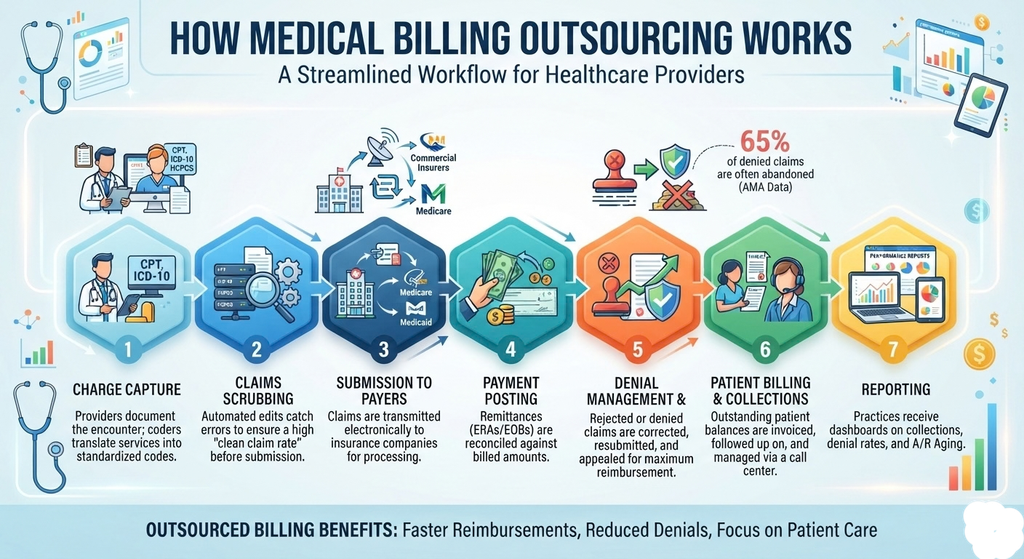
A typical engagement follows a fairly consistent workflow, regardless of vendor:
- Charge capture – Providers document the encounter; coders translate it into CPT, ICD-10, and HCPCS codes.
- Claims scrubbing – The vendor runs claims through automated edits to catch errors before submission, which is what drives a high “clean claim rate.”
- Submission to payers – Claims go out electronically via clearinghouses to commercial insurers, Medicare, and Medicaid.
- Payment posting – Remittances (ERAs/EOBs) are reconciled against what was billed.
- Denial management and appeals – Rejected or denied claims are corrected and resubmitted. This step matters more than most practices realize: industry data cited by the American Medical Association suggests roughly 65% of denied claims are never corrected and resubmitted at all – meaning that revenue is simply abandoned.
- Patient billing and collections – Outstanding patient balances are invoiced and followed up on, often with a patient-facing call center component.
- Reporting – Practices get dashboards or periodic reports on collections, denial rates, and A/R aging.
Most reputable vendors offer a 60-90 day transition timeline: data migration and system testing in the first two weeks, staff training and parallel processing through week six, and a gradual handoff with monitoring through week twelve. Expect a side-by-side “parallel run” period where your existing process and the new vendor both operate before you fully cut over – this protects cash flow during the switch.
Medical Billing Outsourcing Pricing Models and Costs
Pricing is where most practices get surprised, mainly because vendors structure fees in genuinely different ways. There are three common models.
Percentage-of-collections
The most widely used model charges a percentage of what the vendor actually collects on your behalf – typically 4-10% of collections, with 5-8% common for small to mid-size practices. Because the fee is a percentage, the vendor is financially motivated to work denials and chase down underpayments, since they only get paid when you get paid.
The trade-off: cost rises automatically as revenue grows. A practice collecting $2 million a year at a 6% rate pays roughly $120,000 annually to its billing partner – compare that to an in-house team that, as described below, can easily run $150,000-$290,000 once salaries, benefits, and software are included.
Per-claim pricing
Some vendors charge a flat $2-$12 per claim submitted, independent of the dollar amount collected. This gives predictable, volume-based costs, but it doesn’t inherently reward the vendor for maximizing collections on larger or more complex claims the way a percentage model does.
Dedicated FTE / staffing model
A growing alternative is paying for a dedicated outsourced billing employee (or small team) at an hourly or monthly rate rather than a percentage of revenue:
| Tier | Typical Monthly Cost | Approx. Hourly Rate |
|---|---|---|
| Entry-level biller | ~$1,260/month | ~$7.50/hr |
| Mid-level biller | ~$1,596/month | ~$9.50/hr |
| Certified coder / expert | ~$2,100/month | ~$12.50/hr |
This model tends to break even against a U.S. in-house hire (fully loaded, often $5,500+/month with benefits) once a practice is collecting roughly $1.5M+ annually at the entry tier, or $2.5M+ at the expert tier. It works best for practices with steady, predictable claim volume that want a named point of contact rather than a shared vendor queue.
What in-house billing really costs
For context, a mid-sized practice running billing entirely in-house is typically looking at:
- Salaries for 2-3 FTEs: $80,000-$180,000/year
- Benefits: $24,000-$54,000/year
- Practice management software: $6,000-$24,000/year
- Clearinghouse fees: $3,000-$12,000/year
- Training and turnover costs: $2,000-$8,000/year
Total: roughly $120,000-$290,000 per year – and that figure doesn’t account for the revenue lost to denied claims that never get reworked, or the disruption every time a biller quits.
Watch for hidden fees
Before signing, ask vendors to itemize: setup/onboarding fees ($500-$5,000 is common), monthly technology or software access fees, patient statement/collection-letter charges, custom reporting fees, and contract termination or data-export penalties. A vendor with a low headline percentage can still end up more expensive once these are added in.
Benefits of Outsourcing Medical Billing
- Higher net collection rates. Practices commonly see net collection rates move from roughly 75-85% in-house to 92-98% with a specialized RCM partner, simply because denial follow-up is someone’s full-time job.
- Converts fixed costs to variable costs. Percentage-based pricing scales down automatically during slow months, something a salaried in-house team can’t do.
- Eliminates staffing disruption. Billing is a high-turnover role; outsourcing removes the recruiting, training, and coverage gaps that come with it.
- Scalability without hiring. Volume spikes – a new provider joining the practice, a seasonal surge – are absorbed by the vendor’s existing team.
- Reduced administrative burden on clinical staff, which several industry sources tie directly to lower provider burnout.
Risks and Drawbacks to Weigh
- Less day-to-day control. You’re relying on another organization’s processes, staff, and prioritization.
- Cost scales with revenue under percentage models – a growing practice’s billing cost grows right along with it.
- Transition risk. A rushed or poorly managed 60-90 day cutover can create a temporary dip in cash flow if not handled with a proper parallel-run period.
- Vendor quality varies widely. Percentage ranges and collection-rate claims are largely vendor-published, so performance guarantees belong in the contract, not just the sales deck.
- Not a fit for every practice. Solo practitioners with very low claim volume, or organizations with no documented billing process at all, often see less value from outsourcing until volume or process maturity increases.
HIPAA Compliance and Data Security Requirements
Medical billing involves protected health information (PHI) at every step, so HIPAA compliance isn’t optional – it’s the baseline for evaluating any vendor. At minimum, a reputable medical billing outsourcing partner should maintain:
- A signed Business Associate Agreement (BAA) in place before any patient data is shared
- Annual HIPAA security risk assessments
- Encrypted data transmission and storage, both in transit and at rest
- Role-based access controls and audit logging
- Documented staff training on HIPAA Privacy and Security Rules
- A documented incident response plan
- BAAs extended to any subcontractors or subvendors the billing partner uses
- Cyber liability insurance
Note that HIPAA does permit covered entities to use vendors or cloud infrastructure located outside the United States, provided a proper BAA is in place – but practices should confirm exactly where PHI is stored and processed, and require that detail in writing before signing. For more on vetting outsourced partners against this standard, see our guide to HIPAA-compliant call center outsourcing.
Top Use Cases for Medical Billing Outsourcing
Medical billing outsourcing tends to deliver the clearest return in a few recurring scenarios:
- Persistent billing staff turnover – practices that can’t keep a biller or coder on staff long enough to build institutional knowledge.
- High or rising denial rates – especially when internal staff lack time to work appeals, leaving revenue uncollected.
- Multi-payer complexity – practices juggling Medicare, Medicaid, and a wide range of commercial payer rules benefit from a team that specializes in payer-specific requirements full time.
- Growth or multi-location expansion – adding providers or locations without proportionally scaling the back office.
- Specialty practices with complex coding (e.g., multi-specialty groups, surgical practices) that need certified coders rather than generalist staff.
- Small practices facing fixed-cost pressure, where a full in-house billing department isn’t cost-justified relative to revenue.
How to Choose a Medical Billing Outsourcing Partner
Before signing a contract, ask prospective vendors to answer – and document in the contract – the following:
- What is your average net collection rate for practices of our size and specialty?
- What is your typical clean claim rate, and how is it measured?
- What are your benchmarks for days in A/R and denial rate, and are any of these contractually guaranteed?
- What is your staff turnover rate, and how do you maintain continuity on our account?
- Will we have a dedicated account manager, and how often will we receive reporting?
- How does your system integrate with our existing EHR and practice management software?
- Can you provide references from practices in our specialty?
As a benchmark, strong RCM performance generally looks like a 95-98% clean claim rate, under 35 days in A/R, a net collection rate above 95%, a denial rate under 5%, and a first-pass resolution rate above 90%. Vague answers, resistance to transparent reporting, or no specialty-specific references are red flags worth taking seriously. Our 10-point vendor checklist covers the same due-diligence process in more depth.
FAQ
How much does it cost to outsource medical billing?
Most practices pay either 4-10% of collections (commonly 5-8% for small-to-mid-size practices), a flat $2-$12 per claim, or a dedicated-staffing fee of roughly $1,260-$2,100 per month per biller, depending on experience level. The right model depends on claim volume, revenue predictability, and how much control you want over day-to-day billing work.
Is medical billing outsourcing HIPAA compliant?
It can be, provided the vendor signs a Business Associate Agreement, encrypts PHI in transit and at rest, performs regular security risk assessments, and extends the same requirements to any subcontractors it uses. Confirm these safeguards in writing before sharing any patient data.
How long does it take to transition to an outsourced billing partner?
A realistic timeline is 60-90 days from contract signing to full operational handoff, typically phased across data migration, staff training, a parallel-processing period, and a gradual cutover with ongoing monitoring.
Does outsourcing medical billing actually improve collections?
For many practices, yes – net collection rates commonly move from roughly 75-85% in-house to 92-98% with a specialized outsourced partner, mainly because denial management becomes a dedicated, full-time function rather than something squeezed in between other tasks.
Is outsourcing worth it for a small practice?
It depends on volume. Outsourcing tends to pay off once a practice has steady, predictable claim volume and an established billing process; very low-volume solo practices, or those with no documented billing workflow at all, sometimes see less value until they reach that point.
The Bottom Line
Medical billing outsourcing isn’t a one-size-fits-all decision – the right pricing model and vendor depend on your claim volume, specialty mix, and how much oversight you want to retain. But for practices wrestling with denials, staffing turnover, or a billing department that’s maxed out, a specialized RCM partner can convert a fixed cost center into a variable, performance-aligned one – often while improving collections at the same time.
If your organization is evaluating whether to bring in outsourced support for billing, patient scheduling, or broader healthcare BPO functions, see our complete guide to medical process outsourcing for a full breakdown of what else can move off your internal team’s plate.