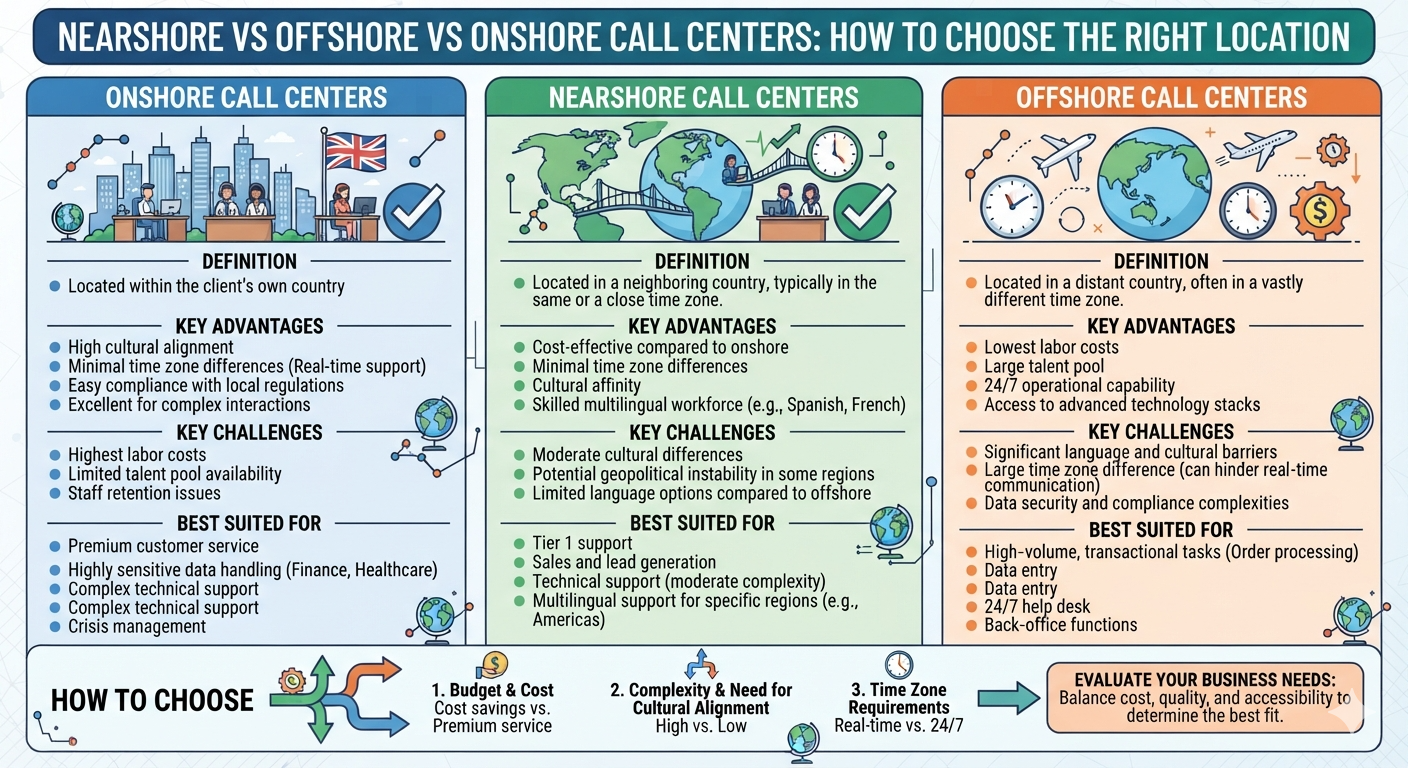
Choosing where to outsource your call center is one of the most consequential decisions in a customer experience strategy. It affects your cost structure, the hours you can staff, how naturally agents connect with your customers, and how exposed you are to compliance risk. The nearshore vs offshore call center decision – and where onshore fits into it – comes down to a trade-off between price and proximity, and there is no universally “right” answer.
This guide breaks down what nearshore, offshore, and onshore actually mean, compares them across the factors that matter most to a growing business, and gives you a practical framework for choosing the right model for your support operation.
Suggested internal link: Call Center Outsourcing: The Complete Guide for Growing Businesses
What Do Nearshore, Offshore, and Onshore Actually Mean?
Before comparing costs and capabilities, it helps to define the terms clearly, since they’re often used loosely in vendor marketing.
- Onshore outsourcing means partnering with a call center located in your own country. For a US-based company, that’s a contact center somewhere in the United States.
- Nearshore outsourcing means partnering with a provider in a nearby country, typically one that shares a similar time zone and, often, cultural or linguistic ties. For US companies, that usually means Mexico, Colombia, Costa Rica, or other Latin American and Caribbean nations. European companies commonly nearshore to Eastern Europe or North Africa.
- Offshore outsourcing means partnering with a provider in a distant country, most often across an ocean, where labor costs are significantly lower. The Philippines and India remain the two largest offshore hubs for English-language customer support.
Each model sits at a different point on the cost-versus-proximity spectrum, and understanding where your priorities fall is the first step in choosing correctly.
Cost Comparison: What Each Model Actually Costs
Cost is usually the first question a business asks, and it’s also the factor most often oversimplified. Headline hourly rates in 2026 look roughly like this:
| Model | Typical Hourly Rate (2026) | Relative Cost |
|---|---|---|
| Onshore (US/Canada) | $35–$48/hr | Highest |
| Nearshore (Latin America/Caribbean) | $12–$18/hr | Moderate |
| Offshore (Philippines/India) | $6–$14/hr | Lowest |
Offshore rates look like the obvious winner on paper, and for high-volume, non-voice, or back-office work, they often are. But headline hourly cost isn’t the whole story. Once you factor in agent attrition, retraining costs, quality assurance overhead, and management time spent bridging time-zone gaps, the gap narrows considerably. Industry analysis suggests nearshore’s real total cost of ownership often runs only 10–20% higher than offshore once these hidden costs are included – a much smaller premium than the headline hourly rates suggest.
Related reading: Call Center Outsourcing Cost in 2026: Full Pricing Breakdown
Attrition is a meaningful part of that hidden cost. Offshore hubs like the Philippines have historically reported contact center attrition in the 43–45% range, meaning nearly half the workforce turns over annually. High turnover translates directly into retraining costs, inconsistent quality, and knowledge loss on your account – costs that don’t show up in the quoted hourly rate but absolutely show up in your outcomes.
Hidden Costs That Don’t Show Up in the Hourly Rate
A quoted hourly rate is only the starting point for a real cost comparison. Before signing with any provider, ask about these line items, since they can shift the total cost of ownership significantly:
- Ramp-up and training costs. Offshore providers with high attrition need to retrain replacement agents constantly, and each retraining cycle is typically billed back to the client in some form, whether directly or through lower early-tenure productivity.
- Quality assurance overhead. Teams with larger cultural or language gaps from your customer base often require more QA review, more call calibration sessions, and more management time from your side to keep quality consistent.
- Technology and integration fees. Some providers charge separately for CRM integration, telephony setup, or reporting dashboards – costs that can vary widely between onshore, nearshore, and offshore vendors regardless of the headline labor rate.
- Travel and oversight. Onshore and nearshore sites are far easier and cheaper to visit in person for audits, training, or relationship management than offshore sites on the other side of the globe.
When you build out a true cost comparison, request an all-in rate that includes these factors rather than comparing bare hourly wages across models.
Time Zone Alignment and Real-Time Collaboration
Time zone overlap determines how easily your outsourced team can function as an extension of your own – rather than a separate operation you hand off to overnight.
- Onshore providers operate in your exact time zone, or close to it, enabling full real-time collaboration, live coaching, and immediate escalation paths.
- Nearshore providers in Latin America typically align closely with US Eastern and Central time zones, often with zero or minimal lag. This makes live supervision, same-day feedback loops, and real-time escalations practical.
- Offshore providers in the Philippines or India typically run 8-13 hours ahead of US time zones. This works well for follow-the-sun coverage models and asynchronous work, but it requires agents to work overnight shifts to serve US customers in real time – which can affect performance and retention over time.
If your support model depends on tight collaboration between your in-house team and your outsourced agents – live escalations, real-time coaching, frequent process changes – time zone overlap should weigh heavily in your decision. If your work is largely asynchronous (ticket triage, back-office processing, after-hours coverage), the time difference is far less of a constraint.
Language and Cultural Fit
Language proficiency and cultural alignment directly affect customer satisfaction, especially for voice-based, emotionally sensitive, or complex interactions.
- Onshore agents offer native-language fluency and maximum cultural familiarity with your customer base, which matters most for premium brand experiences or highly nuanced conversations.
- Nearshore agents, particularly in the Caribbean and increasingly in Latin America, often include large pools of native or near-native English speakers with strong cultural alignment to US consumer expectations – sports references, idioms, holidays, and shopping patterns translate naturally.
- Offshore agents typically operate in English as a strong second language. Quality has improved significantly over the past decade, but cultural distance can still surface in idiom comprehension, tone calibration, or handling ambiguity in customer requests.
For B2B support, technical troubleshooting, or straightforward transactional interactions, offshore language quality is generally more than sufficient. For high-empathy consumer interactions – healthcare, financial hardship, retention calls – the smaller cultural gap of a nearshore or onshore team can measurably improve customer sentiment.
Suggested internal link: Inbound vs Outbound Call Center Services: Which Does Your Business Need?
Data Security and Regulatory Compliance
Compliance requirements have become a bigger factor in the location decision in recent years, particularly for regulated industries.
- Onshore providers operate under the same legal and regulatory framework as your business, which typically makes compliance the most straightforward – a meaningful advantage for healthcare (HIPAA), financial services, and other regulated sectors.
- Nearshore providers usually operate under legal systems with some familiarity to US frameworks, and single-country nearshore operations are generally easier to audit and disclose. US regulators have also increased scrutiny of where customer service work is performed: FCC rules that took effect in late 2024 require companies to disclose to consumers when their call is handled by an overseas contact center, which has pushed some businesses to reassess offshore arrangements for consumer-facing voice work.
Suggested external link: FCC ruling on offshore call center disclosure requirements
- Offshore providers, particularly those running multi-region operations, can present more complexity around data sovereignty, cross-border data transfer rules, and the disclosure requirements noted above.
If your business handles protected health information, financial account data, or operates under strict state or federal consumer protection rules, factor compliance complexity into the location decision early – it can outweigh a lower hourly rate if a compliance misstep creates regulatory exposure.
Best Use Cases for Each Model
No single model is universally superior. The right choice depends on the type of work, the sensitivity of the interaction, and your budget.
| Model | Best Suited For |
|---|---|
| Onshore | Regulated industries, complex technical support, premium/VIP customer experience, licensed financial or legal work |
| Nearshore | Real-time voice support, live sales and retention calls, B2B outreach, work requiring frequent coaching or process iteration |
| Offshore | High-volume back-office processing, non-voice support (chat/email), 24/7 follow-the-sun coverage, data entry and back-office operations |
Many established BPO relationships also use a blended model – for example, offshore agents handling high-volume tier-1 chat support around the clock, while a nearshore team handles live voice calls and escalations during core business hours. This lets a company capture offshore cost savings on high-volume, lower-complexity work while keeping high-stakes interactions closer to home.
To make this concrete, consider three common scenarios:
- A DTC ecommerce brand with seasonal order-status and returns questions might route routine chat and email tickets offshore, where cost efficiency matters most on high volume, while keeping a small nearshore team for phone escalations during checkout season.
- A healthcare services company handling patient scheduling and billing questions typically leans onshore or nearshore, since HIPAA exposure and the sensitivity of health-related conversations make compliance and cultural fit more important than the lowest possible rate.
- A SaaS company offering 24/7 technical support often blends offshore coverage for overnight and weekend tiers with an onshore or nearshore team handling business-hours escalations and enterprise accounts that expect a higher-touch experience.
How to Choose the Right Location for Your Business
Use these questions to guide the decision:
- How real-time does support need to be? If live coaching, immediate escalation, and same-day process changes matter, weight your decision toward nearshore or onshore.
- How price-sensitive is the work? High-volume, lower-complexity interactions can usually tolerate more cultural and time-zone distance, making offshore the more efficient choice.
- What’s your regulatory exposure? Healthcare, financial services, and other regulated industries should weigh compliance complexity as heavily as cost.
- How emotionally sensitive are the interactions? Retention calls, complaints, and healthcare-adjacent conversations benefit from the cultural and linguistic closeness of nearshore or onshore teams.
- Do you need 24/7 coverage? Offshore’s time-zone distance, which is a drawback for real-time collaboration, becomes an advantage for round-the-clock, follow-the-sun staffing.
- What’s your total cost tolerance – not just the hourly rate? Factor in attrition, quality assurance, training, and management overhead, not just the quoted per-hour price.
Related reading: Contact Center Services vs Call Center Services: What’s the Difference?
A structured vendor evaluation – checking attrition rates, security certifications, and reference accounts in your industry – matters more than the location label alone. Two nearshore providers can differ as much from each other as a nearshore provider differs from an offshore one.
FAQ
What is the difference between nearshore and offshore call centers?
Nearshore call centers are located in nearby countries with time-zone overlap and cultural similarity to your market – for US companies, that typically means Latin America or the Caribbean. Offshore call centers are located in distant countries, most commonly the Philippines or India, offering lower labor costs but larger time-zone gaps and more cultural distance.
Is nearshore or offshore cheaper for call center outsourcing?
Offshore typically has the lowest headline hourly rate, often $6–$14/hour compared to $12–$18/hour for nearshore. However, once attrition, retraining, and management overhead are factored in, the total cost gap between nearshore and offshore is often much smaller than the hourly rate difference suggests.
Which is better for compliance-sensitive industries – nearshore or offshore?
Onshore is generally the simplest for compliance, since it operates under the same legal framework as your business. Nearshore is usually easier to audit and disclose than offshore, particularly for consumer-facing voice work now subject to FCC disclosure requirements for overseas call handling.
Can I use a mix of onshore, nearshore, and offshore support?
Yes. Many companies use a blended model – offshore teams for high-volume, non-voice, or after-hours work, and nearshore or onshore teams for live voice support, escalations, and regulated interactions. This captures cost savings where they matter most while protecting quality where it matters most.
What industries typically choose onshore call centers over nearshore or offshore?
Healthcare, financial services, insurance, and other heavily regulated industries most often choose onshore or nearshore models, since compliance requirements and the sensitivity of customer interactions make proximity and legal familiarity a priority over the lowest possible hourly rate.
Conclusion
There’s no single best answer to the nearshore vs offshore vs onshore question – only the answer that’s right for your specific mix of budget, compliance requirements, and customer experience goals. High-volume, lower-complexity, or after-hours work tends to favor offshore’s cost advantage. Real-time, high-empathy, or regulated interactions tend to favor nearshore or onshore’s proximity and compliance simplicity. Most growing businesses land somewhere in between, using a blended approach that puts each type of interaction with the model best suited to handle it.
If you’re evaluating outsourcing partners across these models, HyperOutsource can help you map your support volume, compliance needs, and budget to the right location strategy – whether that’s a single-region team or a blended nearshore/offshore approach.
Suggested internal link: Talk to an Outsourcing Specialist