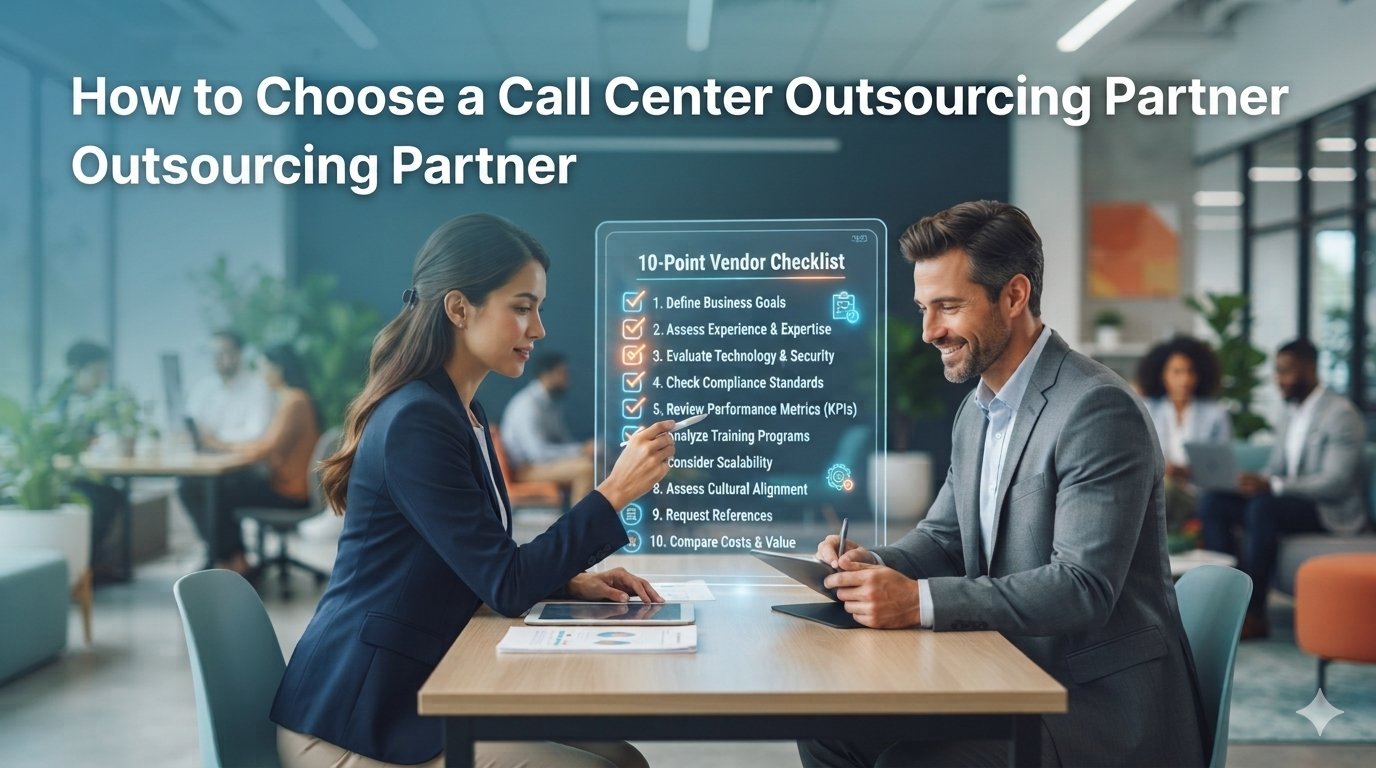
Picking a call center outsourcing partner is not like picking a software vendor. You are handing a stranger your brand voice, your customers’ payment and health information, and hundreds of live conversations a day. If the fit is wrong, you find out from angry customers and missed renewals, not from a dashboard. Whether you have already scoped what call center outsourcing means for your business or you are staring at three vendor proposals with three different pricing structures, the gap between a good hire and an expensive mistake almost always comes down to how rigorously you vet the partner before you sign.
This checklist walks through the ten things worth verifying on every vendor on your shortlist, from security certifications to pricing models to the fine print in the service level agreement, so you can compare quotes apples to apples and catch the red flags before they become your problem.
Why Vendor Selection Is the Highest-Leverage Decision You Will Make
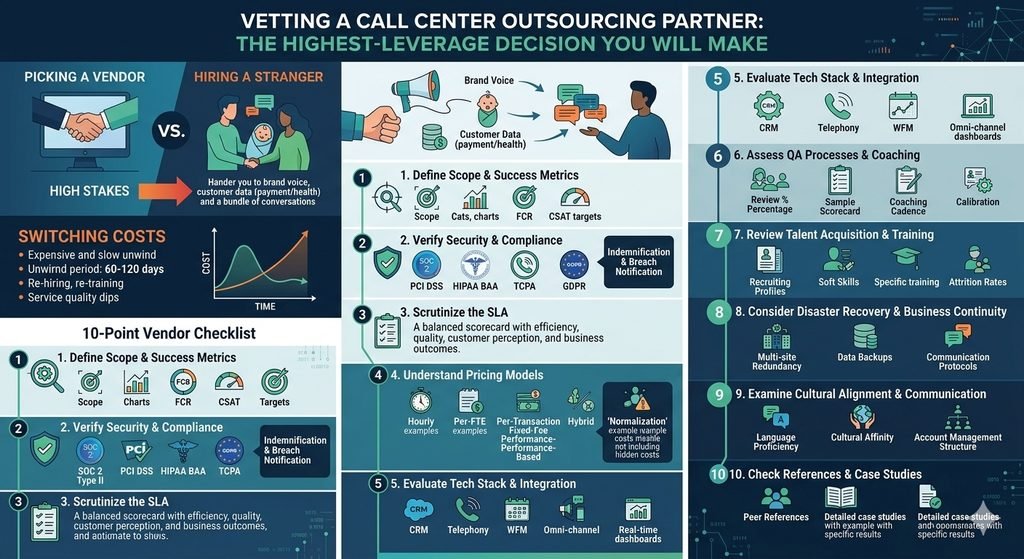
Switching call center vendors mid-contract is expensive and slow. You are looking at 60 to 120 days to unwind a relationship, re-run a hiring and training cycle with a new partner, and absorb a dip in service quality while agents ramp up on your product. That switching cost is exactly why the evaluation phase deserves more time than most buyers give it. A vendor that looks identical to a competitor on a one-page proposal can differ enormously in agent tenure, quality assurance rigor, and how they handle a bad week. The ten checks below are designed to surface those differences before you are locked into a 12-month contract.
The 10-Point Vendor Checklist
1. Define Your Scope and Success Metrics Before You Talk to Vendors
Before you request a single proposal, write down what you are actually outsourcing and what “good” looks like. Are you handing off inbound support, outbound sales, or a mix of both? What volume are you running today, and what does peak season look like? Vendors price and staff very differently depending on whether the work is scripted tier-1 support or judgment-heavy technical troubleshooting.
Set your target metrics in writing first: response time, first contact resolution, CSAT, and whatever business outcome you actually care about, such as renewals saved, tickets deflected, or orders processed. Vendors who ask you hard questions about these targets during the sales process are usually the ones who will hold themselves accountable to them later. Vendors who skip straight to a per-hour rate without asking about your quality bar are telling you something too.
2. Verify Security and Compliance Certifications
This is the check most buyers under-invest in, and it is the one that causes the most expensive failures. At minimum, ask for current SOC 2 Type II certification, not “in progress” or “planned.” SOC 2 Type II means an independent auditor has verified the vendor’s security controls over a period of months, not just on paper.
If your business touches payment data in any way, including a card number read aloud during a call, you need a vendor with PCI DSS compliance, since credit card numbers captured in call recordings are one of the most common compliance violations outsourcers commit. If you operate in healthcare or handle any protected health information, you need a signed Business Associate Agreement before a single patient record is shared, plus evidence of HIPAA-specific training for every agent who will touch that data. Our guide to HIPAA-compliant call center outsourcing breaks down exactly what to ask for. For outbound calling programs, confirm the vendor’s TCPA compliance process, and if you serve EU or California customers, ask how they handle GDPR and state privacy law requirements like the CCPA.
Beyond the certifications themselves, get the contract language in writing: indemnification for regulatory violations, audit rights so you can inspect their practices, a breach notification window of 24 to 72 hours, and disclosure of any subcontractors who will touch your data. If a vendor hedges, delays, or says “we’re working on it” for more than a couple of these items, treat that as a disqualifying signal, not a negotiating point.
3. Scrutinize the SLA, Not Just Uptime
A weak SLA measures one thing, usually average handle time, and calls it a day. A strong one uses a balanced scorecard across four categories: efficiency metrics like average handle time and response speed, quality indicators like QA scores and first contact resolution, customer perception metrics like CSAT and NPS, and business outcomes like retention and conversion.
Look for quantifiable thresholds with clear measurement methodology and reporting frequency, not vague language like “industry-standard response times.” Ask whether commitments are tiered by priority or customer segment, whether you get daily dashboards plus weekly and monthly business reviews, and what the remediation path looks like when a metric is missed, including escalation steps and corrective-action timelines. A well-run vendor will also cap financial penalties to five or seven critical KPIs rather than dozens, since over-penalizing every metric tends to incentivize agents to game a number instead of actually solving the customer’s problem.
4. Understand the Pricing Model and Normalize the Quotes
Call center outsourcing pricing comes in several structures, and vendors will often quote in whichever unit makes their number look smallest. Hourly or per-agent pricing, roughly $8 to $15 an hour offshore, $14 to $22 nearshore, and $30 to $45 onshore, offers flexibility but no efficiency incentive. Per-FTE monthly pricing buys dedicated, trained headcount but means you pay for idle time during slow periods. Per-transaction pricing, billed per ticket, call, or chat, aligns cost with output but needs strong QA oversight on your side, since speed incentives can erode quality. Fixed-fee pricing offers budget certainty for well-defined scope but usually gets renegotiated every four to six months as the work inevitably shifts. Performance-based pricing ties payment to measurable outcomes like resolutions or retained accounts, which is powerful when the outcome is unambiguous but hard to structure when it is not. Most mid-market engagements land on a hybrid: a base FTE block sized to steady-state volume, with an overflow trigger, typically around 110 to 120 percent of that block, billed at a premium.
Whatever model a vendor proposes, normalize every quote to a single comparable unit, usually cost per resolved contact, before you compare them side by side. Then load in the hidden costs vendors rarely put in the headline number: transition and ramp fees, technology integration, and the internal management overhead of running the relationship, which typically adds 10 to 25 percent to the sticker price. If a proposal looks dramatically cheaper than the rest, that gap is coming from somewhere. Our breakdown of call center outsourcing cost walks through the full math region by region.
5. Evaluate the Technology Stack and Integration Fit
Ask exactly which CRM, telephony, and workforce management platforms the vendor runs on, and whether they will work inside your existing stack or ask you to migrate to theirs. A vendor forcing you onto a system you did not choose adds risk and switching cost down the road. Confirm how call recording, quality monitoring, and reporting are handled, whether real-time dashboards are available to you directly rather than just in a monthly PDF, and how they support omnichannel work if you need phone, chat, and email handled by the same team. If AI-assisted tools like conversation intelligence or agent-assist software are part of the pitch, ask for evidence of results, not a demo.
6. Assess QA Processes and Coaching Cadence
A vendor’s quality assurance program is often the single best predictor of how the relationship will actually feel six months in. Ask what percentage of interactions get reviewed, who reviews them, and how often agents receive coaching based on those reviews. Ask to see a sample scorecard. Find out how calibration works between your QA expectations and theirs, since “sounds friendly” and “resolved the actual issue” are two different things vendors sometimes conflate. Vendors with a dedicated QA team separate from the operations team, rather than supervisors grading their own agents, tend to catch problems earlier.
7. Check Scalability and Surge Capacity
Ask how quickly the vendor can add trained headcount for a seasonal spike or a product launch, and how they handle a sudden drop in volume. What is their agent attrition rate, since industry-wide BPO attrition runs in the 49 to 53 percent annual range and directly affects how much institutional knowledge you retain. Ask about cross-training: can agents flex between programs during quiet periods, or does every seat sit idle the moment volume dips. A vendor who cannot answer these questions with real numbers has probably not been tested by a real surge before.
8. Weigh Delivery Location, Language, and Cultural Fit
Where your outsourced team sits affects cost, time zone coverage, language accuracy, and how naturally agents connect with your customers. Onshore, nearshore, and offshore delivery each come with real tradeoffs in price, availability, and communication fit, and the right answer depends on your customer base and budget more than any general rule. If your customers are bilingual or multilingual, confirm native-level fluency, not just conversational ability, and ask to sit in on live calls or listen to recordings before you commit. Our comparison of nearshore vs offshore call centers goes deeper on how to weigh location against your specific requirements. If your program is a genuine mix of high-volume inbound support and proactive outbound outreach, it is also worth revisiting the differences between inbound and outbound call center services, since the two require different agent skill sets and staffing models.
9. Ask for References and Run a Pilot
Request two or three references in your industry, ideally at a similar volume and complexity to your own program, and actually call them. Ask what went wrong, not just what went right, and how the vendor responded when it did. Before you sign a full 12-month agreement, push for a paid pilot, typically 30 to 90 days, on a slice of real volume. A pilot is the only way to see actual agent quality, real QA rigor, and how account management responds under live conditions, rather than what a sales deck promises.
10. Read the Contract for Flexibility, Audit Rights, and Exit Terms
Finally, before you sign anything, read the contract for what happens when things change. Can you adjust volume up or down without penalty, and how much notice does that require? Do you have audit rights to inspect security practices and QA records directly, not just receive a summary? What is the process and notice period to exit the contract if performance does not hold up, and does the vendor own your call recordings and customer data, or do you retain full rights to export it on the way out? These terms rarely come up during the sales pitch, which is exactly why they need a careful read before signature.
Red Flags That Should Make You Walk Away
A few signals are worth treating as deal-breakers rather than negotiating points: a vendor that cannot produce a current SOC 2 Type II report on request, pricing that is dramatically below every other quote with no clear explanation, reluctance to let you speak with references or observe live calls, an SLA built around a single metric instead of a balanced scorecard, and vague answers about where your data physically lives and who can access it. Any one of these on its own is a reason to ask harder questions. Two or more together is a reason to move to the next vendor on your list.
A Simple Vendor Scorecard You Can Use Today
You do not need an elaborate RFP process to apply this checklist. A simple spreadsheet with the ten categories above as rows and each vendor as a column, scored 1 to 5 with notes on specifics like certification status, quoted pricing model, and pilot availability, is usually enough to separate a serious partner from a vendor optimized to win the deal and figure out delivery later.
FAQ
How long does it take to onboard a new call center outsourcing partner?
Most programs take 60 to 120 days from signed contract to full production, covering hiring, training, systems integration, and a ramp period where quality is monitored closely before volume scales up. Complex, highly regulated programs like healthcare or financial services typically run toward the longer end of that range.
What is a reasonable pilot period before signing a full contract?
Thirty to ninety days on a real but limited slice of volume is standard. A pilot should be long enough to see a full weekly cycle of performance, including at least one difficult day, rather than just a clean first week.
Should I choose one vendor or split volume across multiple providers?
Many mid-size and enterprise buyers deliberately split volume across two vendors, or across two delivery locations with the same vendor, to reduce single-point-of-failure risk and create a natural performance benchmark. The tradeoff is added management overhead, so this usually makes sense once volume is large enough to justify a dedicated internal vendor manager.
Do I need a different vendor for inbound support versus outbound sales?
Not necessarily the same team, but the two require different hiring profiles, training, and compensation structures, so confirm the vendor has demonstrated experience and dedicated staffing for whichever mix you need rather than assuming one generalist team can do both well.
What happens to my customer data if I switch vendors later?
Your contract should specify that you retain ownership of call recordings, transcripts, and customer data, with a defined process and timeline for the outgoing vendor to export and securely delete that data. Confirm this in writing before you sign, not after you need to exit.
Choosing the Right Partner Is a Process, Not a Gut Call
The vendors who look best on a first call are not always the ones who perform best in month six. Running every proposal through the same ten checks, verifying certifications instead of taking them on faith, normalizing pricing to a real comparable unit, and insisting on a pilot before a full contract, turns vendor selection from a guess into a process you can defend and repeat. If you want a second set of eyes on a shortlist or a proposal, HyperOutsource’s team is happy to walk through what a strong evaluation looks like for your specific program.