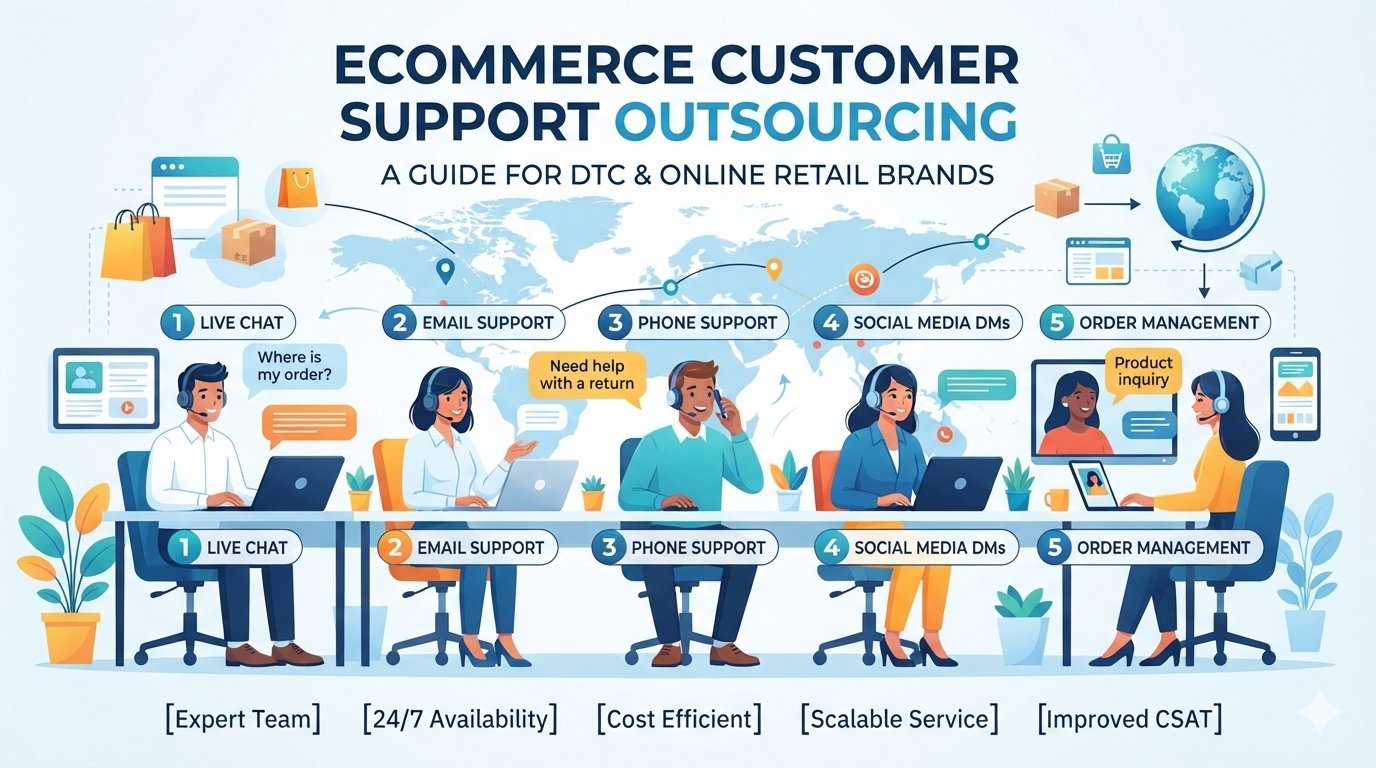
Online shoppers in 2026 expect answers fast, across whatever channel they picked first, and they expect the same brand voice whether they emailed at 9 a.m. or messaged on Instagram at midnight. For DTC and online retail brands, meeting that bar with an internal team alone is getting harder and more expensive every year. That is why a growing number of ecommerce companies are turning to ecommerce customer support outsourcing: hiring a specialized partner to handle some or all of pre-sale questions, order issues, returns, and post-purchase follow-up, instead of hiring, training, and scheduling every agent in-house.
Global ecommerce sales are on track to reach roughly $6.88 trillion in 2026, making up about one-fifth of all retail spending, according to industry estimates. That volume comes with a support problem: Zendesk’s CX Trends research found that 88% of customers now expect faster responses than they got a year earlier, and 74% expect 24/7 availability. Meeting that standard with a purely in-house team, especially through a holiday surge, is where outsourcing starts to make financial and operational sense.
This guide breaks down what ecommerce customer support outsourcing actually includes, what it costs in 2026, how to staff for peak season without burning out a team, and what to look for in a partner before you sign a contract.
The category has grown large enough to support a dedicated vendor landscape of its own. Outsourced customer support overall is estimated at around $360 billion globally in 2026, with the customer-service-specific slice of that market put at roughly $110 billion. Ecommerce and DTC brands are one of the fastest-growing segments inside that total, which means buyers today have far more specialized options than a brand shopping for a support partner five years ago, but also more variation in quality to screen for.
Why More Ecommerce Brands Are Outsourcing Customer Support
Three forces are pushing DTC and online retail brands toward outsourced support at the same time. First, customer expectations have risen faster than most internal teams can scale, especially for brands that sell on Shopify, BigCommerce, or Amazon and compete against companies with much larger support budgets. Second, labor costs for in-house support hires, benefits, software, and management overhead keep climbing, while ecommerce margins stay thin. Third, order volume for most online retailers is anything but steady. A brand that needs six agents in November might only need two in February, and building an in-house team sized for the busiest month of the year wastes money the other eleven.
Many of these brands are simply applying a model that has worked across industries for years. The broader shift toward call center outsourcing has already reshaped how companies in finance, healthcare, and travel handle customer contact, and ecommerce brands are now adapting the same playbook to the specific demands of online retail: order tracking questions, returns logistics, and a buying journey that lives across chat, email, social media, and phone all at once.
What Ecommerce Customer Support Outsourcing Actually Covers
Outsourced ecommerce support is rarely just “answering the phone.” A good partner typically covers some combination of the following:
- Pre-sale chat and product questions (sizing, compatibility, availability)
- Order status and “where is my order” (WISMO) requests, the single highest-volume ticket type for most online retailers
- Returns, exchanges, and refund processing
- Shipping delays, damaged items, and carrier escalations
- Billing, payment, and promo code issues
- Social media and DM support (Instagram, TikTok, Facebook)
- Review response and reputation management
- Multilingual support for international storefronts
Most ecommerce support programs are inbound by design: customers reach out because something came up after they already bought. That is a meaningfully different skill set from the outbound sales or collections work many traditional call centers were built around, so it is worth understanding the distinction between inbound vs outbound call center services before you assume a vendor’s general experience transfers directly to retail support. Some brands do layer outbound work on top, such as abandoned cart follow-up or win-back calls, but the core of ecommerce outsourcing is reactive, high-volume, and channel-diverse.
That channel diversity is also why most ecommerce brands need a contact center model rather than a traditional phone-first call center. If you are weighing the two, our breakdown of contact center services vs call center services explains the practical differences in platform, staffing, and reporting, both of which matter once your support volume spreads across chat, email, and social at the same time.
Reporting and analytics matter just as much as channel coverage. A capable partner should be able to show you ticket volume by category, first response and resolution time by channel, CSAT trends, and recurring issue types (a spike in “wrong item shipped” tickets, for example, points to a fulfillment problem your operations team needs to see, not just a support metric). If your storefront sells internationally, ask specifically how the provider staffs multilingual coverage, since a team that can only support English will cap how far you can expand into new markets.
The Real Cost of Ecommerce Customer Support Outsourcing in 2026
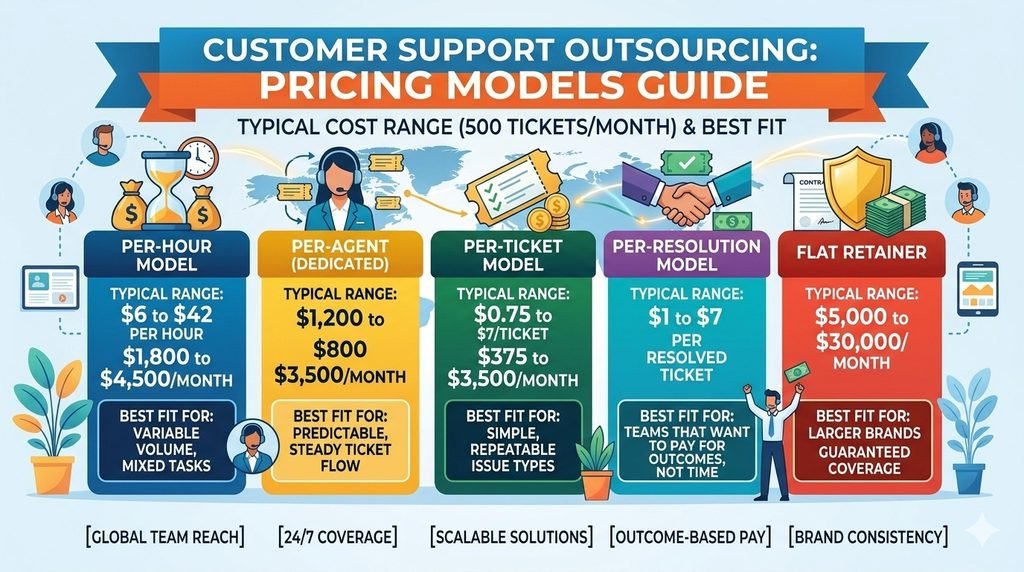
Pricing varies widely depending on ticket volume, channel mix, and where the agents are based. For a mid-sized store handling around 500 tickets a month with one dedicated agent, published 2026 benchmarks put the typical spend somewhere between $1,800 and $4,500 a month, depending on the pricing model. Here is how the common models compare at that volume:
| Pricing model | Typical range (500 tickets/month) | Best fit for |
|---|---|---|
| Per-hour | $6 to $42 per hour ($1,800 to $4,500/month) | Variable volume, mixed tasks |
| Per-agent (dedicated) | $1,200 to $3,500/month | Predictable, steady ticket flow |
| Per-ticket | $0.75 to $7/ticket ($375 to $3,500/month) | Simple, repeatable issue types |
| Per-resolution | $1 to $7 per resolved ticket | Teams that want to pay for outcomes, not time |
| Flat retainer | $5,000 to $30,000/month | Larger brands needing guaranteed coverage |
These figures track closely with broader call center outsourcing cost benchmarks seen across other industries, though ecommerce programs often come in leaner outside of peak months, since a larger share of tickets are self-service-friendly (order status, return label requests) rather than the complex, compliance-heavy calls common in healthcare or financial services.
Hourly rates also shift a lot by region, which is one reason the location question matters as much as the pricing model. Published 2026 ranges run from roughly $25 to $42 an hour in the US and Canada, $12 to $25 in Eastern Europe, $10 to $19 in Latin America, and $6 to $16 in the Philippines, with some providers in India quoting as low as $6 to $12. A US in-house team of five agents can run $350,000 to $530,000 a year in fully loaded costs, against a commonly cited $100,000 to $215,000 for an outsourced equivalent in a lower-cost region, a gap of roughly 50 to 70%. Before committing to a region purely on rate, weigh the tradeoffs covered in our guide to nearshore vs offshore call center options, since time zone overlap, language fluency, and cultural fit with your customer base often matter more than the headline hourly rate once a program is running at scale.
One practical note on these numbers: most published benchmarks come from the outsourcing vendors themselves, and quoted hourly rates frequently exclude onboarding fees (often $500 to $5,000 one-time), QA and management surcharges (5 to 10% on top of the base rate), software integration fees, and after-hours premiums. Ask any vendor for an all-in monthly estimate, not just a base hourly quote, before comparing proposals.
Handling Peak Season Without Breaking Your Support Team
Seasonality is the single biggest reason ecommerce support is a different problem than support for most other industries. Order volume during peak shopping periods commonly reaches three to five times normal levels, and the ticket surge that follows, driven by shipping questions first and then returns, can last for weeks after the sales events end. Post-holiday returns alone totaled an estimated $122 billion in 2024, a 28% increase year over year according to Salesforce data, and that volume lands squarely on the support team.
A few practices separate brands that get through peak season smoothly from those that do not:
- Start planning three to six months ahead, ideally by mid-summer, rather than scrambling in October
- Use a blended model where bots and self-service handle routine, low-complexity requests (order status, return labels) and human agents focus on anything that needs judgment
- Apply tiered escalation, where the outsourced team owns tier-one volume and your in-house specialists handle tier-two and VIP cases
- Set clear SLAs before the surge hits: first response time, average handle time, CSAT, and escalation rate
- Run joint training and brand-voice calibration with the outsourced team well before launch, not during it
One advantage of an established outsourcing partner is speed to scale. A seasoned provider with a trained talent bench can typically stand up an additional pod of agents within days rather than the weeks or months a seasonal in-house hiring push requires, and can contract that team back down just as quickly once the rush passes.
How to Choose an Ecommerce Customer Support Outsourcing Partner
Not every call center vendor is set up to support an online retail brand well. A handful of criteria matter more for ecommerce specifically than they do for other industries:
- Platform experience. Ask whether agents have hands-on experience with your ecommerce stack, Shopify, BigCommerce, WooCommerce, or Magento, plus your order management, shipping, and returns tools.
- Omnichannel capability. Confirm the team can genuinely work chat, email, phone, and social from one unified queue, not three disconnected tools.
- Data security. Payment and order data require real safeguards. Ask directly about PCI compliance, data handling policies, and access controls.
- Defined SLAs and KPIs. First response time, resolution rate, and CSAT targets should be written into the contract, not left as vague promises.
- Peak-season scalability. Ask how quickly the provider can add agents for a surge and how they ramp them down afterward.
- Brand voice training. Your support team is a direct extension of your brand. A partner should have a real onboarding and QA process for matching your tone, not a generic script.
If you want a deeper, channel-agnostic framework for vetting any outsourcing vendor, our guide on how to choose a call center outsourcing company walks through a 10-point checklist that applies just as well to ecommerce-focused providers as it does to any other outsourced support program.
Outsourcing vs Keeping Ecommerce Support In-House
Neither option is universally right. In-house teams give you tighter control over brand voice and institutional knowledge, but they are expensive to scale up and down, and seasonal hiring is slow and costly. Outsourced teams offer lower fully loaded costs and much faster scalability, but require more deliberate work up front on training, QA, and brand alignment. Many growing ecommerce brands land on a hybrid: a small in-house team that owns VIP accounts, escalations, and brand strategy, paired with an outsourced partner that absorbs the bulk of day-to-day ticket volume and flexes for peak season.
A few questions help decide where your brand fits on that spectrum. How predictable is your ticket volume outside of a few peak weeks a year. How much of your support workload is routine (order status, returns) versus complex and judgment-heavy (VIP accounts, disputes, product recalls). And how much in-house bandwidth do you realistically have to manage a vendor relationship well, since even the best outsourced team still needs a point of contact on your side to monitor quality and share product updates.
FAQ
How much does it cost to outsource ecommerce customer support?
For a store handling around 500 tickets a month, expect to spend roughly $1,800 to $4,500 depending on the pricing model (hourly, per-ticket, per-resolution, or dedicated agent). Larger brands handling several thousand tickets a month, especially with 24/7 coverage, commonly spend $7,500 to $15,000 or more, and flat retainers for enterprise-scale programs can run $5,000 to $30,000 a month. Always ask for an all-in quote that includes onboarding, QA, and after-hours fees.
What is the difference between outsourcing ecommerce support and using a general call center?
A general call center is often built primarily around phone-based inbound or outbound calls. Ecommerce support needs a true omnichannel setup that handles chat, email, social media, and phone from one system, plus specific experience with order management, returns, and shipping workflows that do not come up the same way in other industries.
Can outsourced teams handle live chat and social media, not just phone and email?
Yes. Most established ecommerce support providers in 2026 are built around omnichannel platforms that include live chat, email, phone, and social or DM support (Instagram, TikTok, Facebook) in a single queue. When evaluating a vendor, ask for a live demo of their platform handling all of your specific channels, not just a description of capabilities.
How do outsourced teams prepare for Black Friday and the holiday rush?
Experienced partners start planning three to six months ahead, forecasting volume against prior years, pre-training a bench of agents, and agreeing on SLAs before volume spikes. During the surge, most use a blended approach: self-service and bots absorb routine order-status and return questions, while trained agents handle anything that needs judgment or de-escalation.
Is outsourcing ecommerce customer support safe for payment and order data?
It can be, but only with the right partner. Ask any vendor directly about PCI compliance, data access controls, device and network security policies, and how they handle customer data if the relationship ends. A credible provider should be able to answer these questions clearly and point to documented policies, not just verbal assurances.
Getting Started
Ecommerce customer support outsourcing is no longer just a cost-cutting move. For most growing DTC and online retail brands in 2026, it is becoming the practical way to deliver the fast, always-on, omnichannel support that customers now expect, without building and maintaining an oversized in-house team to cover a few peak months a year. The brands that get the most out of it treat vendor selection, SLA design, and peak-season planning as seriously as they treat any other core operations decision.
If you are evaluating outsourced support for your online store, HyperOutsource can help you scope the right staffing model, pricing structure, and peak-season plan for your specific order volume and channel mix.